A lawsuit against Fred Phelps is going all the way to the Supreme Court:
http://www.stltoday.com/news/national/article_47b8dd24-537b-54ab-a17c-a00d790ebf2b.html?mode=story
I suffer from extreme dislike of Mr. Phelps and his Westboro Baptist Church. They picket funerals of AIDS victims, soldiers who have died in the line of duty. They picket Jews, Catholics, and gays. They claim that 9/11 happened because God was angry with the US for tolerating homosexuality.
The lawsuit in question is by a man whose son died in Iraq. Westboro/Phelps picketed his son's funeral. Can you imagine anything more mean-spirited?
Snyder filed suit on the basis that what Westboro did (picketing the funeral and publishing a mean-spirited poem mocking their son's death) constituted harassment.
Is it free speech? Or is it harassment? And when is it considered hate speech? Burning a cross near someone's house is illegal, but picketing a funeral isn't. I don't know what's right in this situation (well... what's right is for the Phelps clan to go home and learn to play nice, but I doubt THAT'S going to happen), but I'd like people to think about it.
Friday, October 1, 2010

Thursday, October 1, 2009
Trick-or-Treat for UNICEF
The American branch of the United Nations Children's Fund (UNICEF) has a program that allows children to get involved in helping others. In addition to the child's candy bag, he or she can carry a UNICEF box as well, and ask for monetary donations (often loose change) to be sent to UNICEF. Consider getting the kids in your area involved. There are also programs that allow you to set up an online donation to Unicef.
Monday, March 30, 2009
Listening and having an open mind
I found an awesome blog post by a guy who knits, and a closed minded minister who thought he shouldn't be doing "women's work" (never mind that in the history of knitting, it was a) originally men's work, and b) often done by the whole family).
No, it's not really about knitting. Nor is it about religion. It's about really LISTENING to each other, and learning to work together, something at which our politicians and everyone else in the world should become proficient.
Here's the post: Strangers on a Train
No, it's not really about knitting. Nor is it about religion. It's about really LISTENING to each other, and learning to work together, something at which our politicians and everyone else in the world should become proficient.
Here's the post: Strangers on a Train
Tuesday, February 24, 2009
Thursday, January 29, 2009
Due process of law for EVERYONE (not just Americans)
As Americans, we have some sacred rights guaranteed to us by the Constitution. We are innocent until proven guilty. We have a right to a trial with a jury of our peers, we have a right to representation, and we are protected against cruel and unusual punishment.
We have these rights, not because they are easy, or convenient, or expedient. We have these rights because some great men realized that they were necessary for a better country, one where the will of The People trumps that of the government.
I'd like to take our forefather's ideas one step farther. We – as a nation, need to extend those rights to the rest of the world. Not because it's easy, but because it's the right thing to do.
It doesn't matter whether someone is American-born or not. A criminal is a criminal, regardless of their citizenship, and we have rules governing how criminals are to be handled. Our rules work pretty well, and despite the problems we do have, we tend to hold our legal and justice system up as a model for the rest of the world. One of the reasons our government used as justification to depose Saddam Hussein was his unfortunate tendency to throw people he didn’t like into prison and let them rot. How is this any different than what we’ve done to the detainees at Guantanamo Bay or the supposed secret prisons that we may or may not have? Haven’t we thrown people we suspect (but haven’t proven guilty) into a prison and let them rot?
But then, I heard on the radio, a caller who said in reference to the proceeding surrounding the closure of the Guantanamo Bay detainment facility, “those people don’t deserve our protections.”
Huh? Why don’t they? Many of those prisoners were detained because they were merely suspected of terrorist activity. If they were merely under suspicion, and not proven, then why wouldn’t they deserve fair treatment? What if they were actually innocent? Why wouldn’t they deserve counsel, the right to present their case, the right to face their accusers, the right show their innocence? Why shouldn’t we be required to PROVE them guilty? And why are those suspected criminals less deserving of humane treatment than any common – though American – murderer?
Question: What's the difference between Timothy McVey and Osama Bin Laden?
Answer: The country of their birth.
Consider Timothy McVey, who is considered the main conspirator in the bombing of the Oklahoma City Murrah Federal Building, on April 19, 1995. Here are some pictures to jog your memory:

168 people died, and 800 were wounded in this attack. Many of the dead were young children, as the blast destroyed a daycare center in the building. The following picture won a Pulitzer:

The firefighter was named Chris Fields, and the baby was named Baylee Almon. Little Baylee died later that day in the hospital.
Now, I ask you this: Was this event any less disturbing than the ones that occurred on September 11, 2001?
McVey, however was arrested, charged with a crime, given representation by lawyers, tried, and convicted. He was put to death by lethal injection just a few months before the events of 09-11-2001. I'm generally against the death penalty (I just can't agree that a government should have the right to put its citizens to death), but I admit to being so horrified by the Oklahoma City bombing that I won't argue the fairness of McVey's punishment.
And what about folks like Ted Bundy, or John Wayne Gacy? Each were convicted of killing and torturing more than 30 people, though the actual number of murders might have been much higher (some experts think Bundy might have been responsible for the deaths of as many as 100 women). Their actions were particularly gruesome, yet they were given the usual protections guaranteed to them by the Constitution. Both were eventually executed. Why did these men “deserve” better treatment? They certainly weren’t better men.
It gets even more complicated and contradictory – our double standard apparently doesn’t extend to foreign-born criminals actually on American soil, and arrested by local police. Those criminals usually ARE afforded the American Constitutional protections. So what gives here? Why would the location of the arrest, who does the arresting, or the type of crime matter in the least?
Yet, the "enemy combatants" captured in the aftermath of the 9-11 attacks being held at Gitmo have been held for years, never charged with a crime, denied lawyers, possibly tortured, and denied many basic rights guaranteed by the Constitution, all as part of the war on terror.
There are so many unanswered questions: Were the people held at Gitmo caught or suspected of criminal activity against Americans? Was it on American soil? Was there any evidence of wrongdoing?
We. Don’t. Know.
We don't even know if these people really are criminals. Maybe some of them are actually innocent (and some have been shown to be innocent). Why is it OK to deny our basic rights to those individuals?
Consider the case of Murat Kurnaz, who was held for 4 years at Guantanamo Bay. There was little evidence against him, (the classified "evidence" against him consisted of an unsigned memo - no photographs, no sworn depositions, no testimony. Just a piece of paper that someone – no one actually knows who - wrote) he was never charged with any crime, he was possibly tortured. So he spent 4 years in Cuba, with no evidence against him, not being allowed to talk freely with family (his letters were heavily censored), and not until the end was he allowed a lawyer. At least we did eventually release him.
So we treated Mr. Kurnaz – very likely an innocent man – as badly as Saddam Hussein did many of his own people. Without knowing if the people we detain in our efforts to curb terrorists, are innocent or not, we as a people cannot ever take the high road, and neither can our government when we allow shameful things like what happened to Mr. Kurnaz, when we deny our own protections to anyone, ever. How can we look our allies in the eyes, point to Saddam Hussein, and say “he imprisoned people wrongly and denied them due process of law” and yet do the very same thing, and then refuse to stop.
How can we Americans allow this? If we are the greatest nation in the world, then we must take the moral high road, and treat the citizens of the world with the same standards with which we treat our own. After all, if it's good enough for an American, it's good enough for everyone else.
We have these rights, not because they are easy, or convenient, or expedient. We have these rights because some great men realized that they were necessary for a better country, one where the will of The People trumps that of the government.
I'd like to take our forefather's ideas one step farther. We – as a nation, need to extend those rights to the rest of the world. Not because it's easy, but because it's the right thing to do.
It doesn't matter whether someone is American-born or not. A criminal is a criminal, regardless of their citizenship, and we have rules governing how criminals are to be handled. Our rules work pretty well, and despite the problems we do have, we tend to hold our legal and justice system up as a model for the rest of the world. One of the reasons our government used as justification to depose Saddam Hussein was his unfortunate tendency to throw people he didn’t like into prison and let them rot. How is this any different than what we’ve done to the detainees at Guantanamo Bay or the supposed secret prisons that we may or may not have? Haven’t we thrown people we suspect (but haven’t proven guilty) into a prison and let them rot?
But then, I heard on the radio, a caller who said in reference to the proceeding surrounding the closure of the Guantanamo Bay detainment facility, “those people don’t deserve our protections.”
Huh? Why don’t they? Many of those prisoners were detained because they were merely suspected of terrorist activity. If they were merely under suspicion, and not proven, then why wouldn’t they deserve fair treatment? What if they were actually innocent? Why wouldn’t they deserve counsel, the right to present their case, the right to face their accusers, the right show their innocence? Why shouldn’t we be required to PROVE them guilty? And why are those suspected criminals less deserving of humane treatment than any common – though American – murderer?
Question: What's the difference between Timothy McVey and Osama Bin Laden?
Answer: The country of their birth.
Consider Timothy McVey, who is considered the main conspirator in the bombing of the Oklahoma City Murrah Federal Building, on April 19, 1995. Here are some pictures to jog your memory:
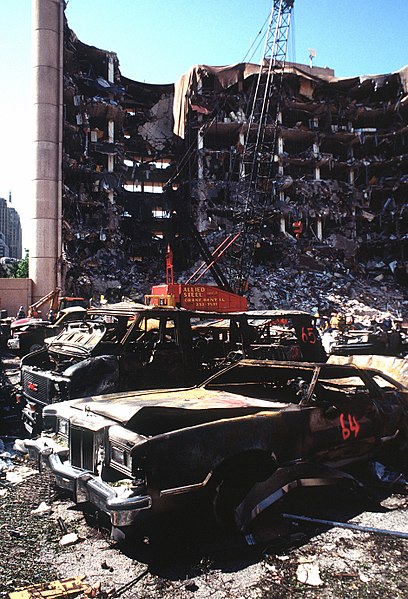
168 people died, and 800 were wounded in this attack. Many of the dead were young children, as the blast destroyed a daycare center in the building. The following picture won a Pulitzer:
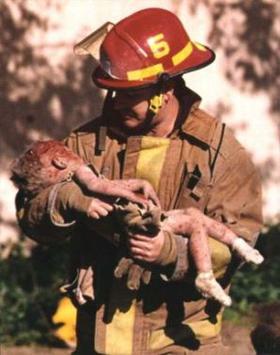
The firefighter was named Chris Fields, and the baby was named Baylee Almon. Little Baylee died later that day in the hospital.
Now, I ask you this: Was this event any less disturbing than the ones that occurred on September 11, 2001?
McVey, however was arrested, charged with a crime, given representation by lawyers, tried, and convicted. He was put to death by lethal injection just a few months before the events of 09-11-2001. I'm generally against the death penalty (I just can't agree that a government should have the right to put its citizens to death), but I admit to being so horrified by the Oklahoma City bombing that I won't argue the fairness of McVey's punishment.
And what about folks like Ted Bundy, or John Wayne Gacy? Each were convicted of killing and torturing more than 30 people, though the actual number of murders might have been much higher (some experts think Bundy might have been responsible for the deaths of as many as 100 women). Their actions were particularly gruesome, yet they were given the usual protections guaranteed to them by the Constitution. Both were eventually executed. Why did these men “deserve” better treatment? They certainly weren’t better men.
It gets even more complicated and contradictory – our double standard apparently doesn’t extend to foreign-born criminals actually on American soil, and arrested by local police. Those criminals usually ARE afforded the American Constitutional protections. So what gives here? Why would the location of the arrest, who does the arresting, or the type of crime matter in the least?
Yet, the "enemy combatants" captured in the aftermath of the 9-11 attacks being held at Gitmo have been held for years, never charged with a crime, denied lawyers, possibly tortured, and denied many basic rights guaranteed by the Constitution, all as part of the war on terror.
There are so many unanswered questions: Were the people held at Gitmo caught or suspected of criminal activity against Americans? Was it on American soil? Was there any evidence of wrongdoing?
We. Don’t. Know.
We don't even know if these people really are criminals. Maybe some of them are actually innocent (and some have been shown to be innocent). Why is it OK to deny our basic rights to those individuals?
Consider the case of Murat Kurnaz, who was held for 4 years at Guantanamo Bay. There was little evidence against him, (the classified "evidence" against him consisted of an unsigned memo - no photographs, no sworn depositions, no testimony. Just a piece of paper that someone – no one actually knows who - wrote) he was never charged with any crime, he was possibly tortured. So he spent 4 years in Cuba, with no evidence against him, not being allowed to talk freely with family (his letters were heavily censored), and not until the end was he allowed a lawyer. At least we did eventually release him.
So we treated Mr. Kurnaz – very likely an innocent man – as badly as Saddam Hussein did many of his own people. Without knowing if the people we detain in our efforts to curb terrorists, are innocent or not, we as a people cannot ever take the high road, and neither can our government when we allow shameful things like what happened to Mr. Kurnaz, when we deny our own protections to anyone, ever. How can we look our allies in the eyes, point to Saddam Hussein, and say “he imprisoned people wrongly and denied them due process of law” and yet do the very same thing, and then refuse to stop.
How can we Americans allow this? If we are the greatest nation in the world, then we must take the moral high road, and treat the citizens of the world with the same standards with which we treat our own. After all, if it's good enough for an American, it's good enough for everyone else.
Upcycling shoes to stamps
One technique for making the world a better place -- something that's been recently interesting lots of people around the world (Cathy and I included) is upcycling; the process of turning something worn out into some new other thing. I frequently read great crafty projects for upcycling and the one I read today inspired me to share it here.
So, if you're interested in turning the soles of old shoes into rubber stamps, you can probably figure it out, but check this for some tips.
So, if you're interested in turning the soles of old shoes into rubber stamps, you can probably figure it out, but check this for some tips.
Eunice Kennedy Shriver
Eunice Kennedy Shriver has worked for 40 years promoting Special Olympics. I don't have any special tie to either, but I've always thought it was a neat organization/event and when I ran across the article on Ms. Shriver above, I figured you might want to see it too!
Wednesday, January 28, 2009
African Soil Map
I have a particular fondness for science and technology. Appropriate Technology is the consideration these things while being mindful of actually making the world a better place, rather than disrupting people to no gain.1
This project to map the African soilscape is most appropriate.
1 Off-topic note: I bear a couple of degrees in technology from the University of Missouri. I once (about fifteen years ago) declared in an upper-level class that Appropriate Technology was a bogus concept because technology is a set of tools that represented progress. I thought at the time that I had an insightful notion about the crushing advance of progress and since it was inexorable to consider this so-called AT was foolish. Turns out I was just a cocky little dumb-ass. Oh well, I guess it happens. Anyway, this is me apologizing to Dr. Michael Wright who was trying to correct my juvenile misperception at the time. :-)
This project to map the African soilscape is most appropriate.
1 Off-topic note: I bear a couple of degrees in technology from the University of Missouri. I once (about fifteen years ago) declared in an upper-level class that Appropriate Technology was a bogus concept because technology is a set of tools that represented progress. I thought at the time that I had an insightful notion about the crushing advance of progress and since it was inexorable to consider this so-called AT was foolish. Turns out I was just a cocky little dumb-ass. Oh well, I guess it happens. Anyway, this is me apologizing to Dr. Michael Wright who was trying to correct my juvenile misperception at the time. :-)
Tuesday, January 27, 2009
The Recession is a Golden Opportunity
(OK, nothing posted for a month. Let's fix that.)
I found this piece by Cardinal Murphy-O'Connor -- the Archbishop of Westminster, published in the Telegraph. It resonates powerfully with me. His focus is on how Christianity requires that as we move through our lives -- in this particular case, as we respond to the current global recession, we strive to make the world better for the disadvantaged. First, I agree with him that this should be the paramount concern of Christians. It was the message of Jesus. But more, this message isn't just for Christians.
This recession is an opportunity. A friend of mine in New York was recently laid off and has taken to volunteering for some nonprofits. As Muphy-O'Connor notes, we can rebuild the economy, but rebuild it a little differently. Maybe this time we can help close the wealth gap between the top and bottom strata of our society. Here's a chance that we can make the world a better place.
I found this piece by Cardinal Murphy-O'Connor -- the Archbishop of Westminster, published in the Telegraph. It resonates powerfully with me. His focus is on how Christianity requires that as we move through our lives -- in this particular case, as we respond to the current global recession, we strive to make the world better for the disadvantaged. First, I agree with him that this should be the paramount concern of Christians. It was the message of Jesus. But more, this message isn't just for Christians.
This recession is an opportunity. A friend of mine in New York was recently laid off and has taken to volunteering for some nonprofits. As Muphy-O'Connor notes, we can rebuild the economy, but rebuild it a little differently. Maybe this time we can help close the wealth gap between the top and bottom strata of our society. Here's a chance that we can make the world a better place.
Friday, December 26, 2008
Happy 43rd Kwanzaa
Happy harvest to those who celebrate Kwanzaa. To those who don't, the principles include ideas we can all benefit from:
- Unity
- Self-determination
- Collective work and responsibility
- Cooperative economics
- Sense of purpose
- Creativity
- Faith
Thursday, December 25, 2008
Merry Christmas
This is a message to our readers who celebrate Christmas: Merry Christmas, peace and goodwill to all.
Sunday, December 21, 2008
Happy Hanukkah
The festival of lights starts today, and goes for eight days, from now until December 29th. Peace and goodwill to all.
Saturday, December 6, 2008
How to avoid Genocide
Study genocides that have happened, and vow not to let it happen again.
Here's an article from CNN.com that talks about the ordinary people that served as concentration camp guards and doctors, often former neighbors or colleagues. These weren't murderers or sociopaths, at least not initially. They were regular people manipulated by their governments into thinking in an "us or them" mentality.
Below is a video of a survivor of the Bosnian Muslim Genocide from the early 1990s. It's not for the faint of heart. I urge you to watch it, and other like it.
It touches directly on a situation in my own background. My grandparents were escaped Jews during WWII, and they lost many close family members to the Holocaust, so it's a topic that has always been a part of my life. I've often wondered if I would be strong enough to survive the horrors that took the lives of so many of my relatives and people like them. But then, I try and turn it around, and wonder if I could be one of the heartless ones who did the killing. And the answer to both questions is "I don't know." I'd like to think I'd be strong enough to survive. And I'd like to think I'd be moral enough to not be party to genocide. But the undeniable truth is that you never know what you are capable of, until you are actually in the situation.
It's probably a fruitless wish, but may we never again need to be in either position. That's my wish for the world.
Here's an article from CNN.com that talks about the ordinary people that served as concentration camp guards and doctors, often former neighbors or colleagues. These weren't murderers or sociopaths, at least not initially. They were regular people manipulated by their governments into thinking in an "us or them" mentality.
Below is a video of a survivor of the Bosnian Muslim Genocide from the early 1990s. It's not for the faint of heart. I urge you to watch it, and other like it.
It touches directly on a situation in my own background. My grandparents were escaped Jews during WWII, and they lost many close family members to the Holocaust, so it's a topic that has always been a part of my life. I've often wondered if I would be strong enough to survive the horrors that took the lives of so many of my relatives and people like them. But then, I try and turn it around, and wonder if I could be one of the heartless ones who did the killing. And the answer to both questions is "I don't know." I'd like to think I'd be strong enough to survive. And I'd like to think I'd be moral enough to not be party to genocide. But the undeniable truth is that you never know what you are capable of, until you are actually in the situation.
It's probably a fruitless wish, but may we never again need to be in either position. That's my wish for the world.
Wednesday, December 3, 2008
UNICEF -The United Nations' Children's Fund
Find info about UNICEF activities in your country. When I was a kid, my church distributed Unicef "friend at my table" boxes, and every evening at dinner we would transfer any loose change in our pockets to the box on the table. I didn't find that same program, but there are others. They sell Christmas Cards among other things. Why not buy your cards from Unicef this year, and help a child in need while doing it?
Tuesday, December 2, 2008
Food Force - the Game
Check out the United Nations World Food Program game - Food Force. I love the idea of making helping others and solving problems FUN.
Monday, December 1, 2008
The Bottom Billion: Why the Poorest Countries are Failing and What Can Be Done About It
I found a recommendation for a book called "The Bottom Billion: Why the Poorest Countries are Failing and What Can Be Done About It" in an article from the Economist, which had this to say:
The book seems to be well-respected at Amazon.com, where it's been given 4.5 stars out of 5.
There's also a Kindle Edition for those who prefer that format.
THIS slip of a book is set to become a classic of the “how to help the world's poorest” genre. Its author, Paul Collier, an Oxford economics professor, has spent 30-odd years puzzling mainly over sub-Saharan Africa and trying to work out why so many of its 48 countries have become basket cases. Crammed with statistical nuggets and common sense, his book should be compulsory reading for anyone embroiled in the hitherto thankless business of trying to pull people out of the pit of poverty where the “bottom billion” of the world's population of 6.6 billion seem irredeemably stuck.
The book seems to be well-respected at Amazon.com, where it's been given 4.5 stars out of 5.
There's also a Kindle Edition
for those who prefer that format.
Sunday, November 30, 2008
Saturday, November 29, 2008
Animals get hungry, too
One of my favorite organizations is the World Wildlife Fund, which is dedicated to saving animals from extinction and starvation. From their mission statement:
We seek to save a planet, a world of life. Reconciling the needs of human beings and the needs of others that share the Earth, we seek to practice conservation that is humane in the broadest sense. We seek to instill in people everywhere a discriminating, yet unabashed, reverence for nature and to balance that reverence with a profound belief in human possibilities. From the smallest community to the largest multinational organization, we seek to inspire others who can advance the cause of conservation.
Friday, November 28, 2008
How to help end world hunger and poverty
Here's an article from eHow that outlines several different things that you can do to help make things better (shop at places that donate proceeds to charity, donate to Goodwill and Salvation Army, hold fundraisers, volunteer at soup kitchens, etc). I like this article because it focuses on relatively simple things that anyone can do to help.
Thursday, November 27, 2008
Fighting hunger article in the Washington Post
In this article entitled "How to Help" from last April, the Washington Post outlines several different food programs that are dedicated to fighting world hunger, including the UN World Food Program, Catholic Relief Services, Care International, Mercy Corps, and World Vision, with links to each program.
Subscribe to:
Posts (Atom)

 Posts
Posts


